If it is education that created this mess, it will be education that gets us out of it. We know making things better will not happen overnight, it will take generations, that’s how the damage was created, and that’s how the damage will be fixed.
His Honourable Murray Sinclair

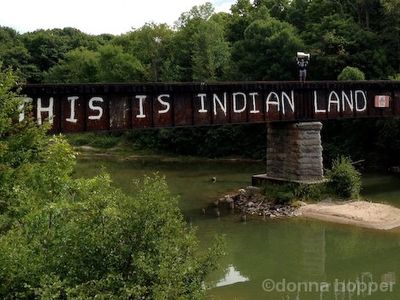
A Bridge, A Story, A Reminder
Like many people who grew up in Northern Ontario, I have travelled Highway 17 more times than I can count. I don't remember the first time I noticed it, but I know I was young: a railway bridge near Garden River First Nation, just east of Sault Ste. Marie when travelling west from Sudbury, bearing the words: THIS IS INDIAN LAND.
For most of my life, I passed beneath those words without knowing their story. Then about six months ago, a post about the bridge appeared in my timeline that....stopped me in my tracks...pun intended! It's such an inspiring story!!
The words were painted on in 1973 by six members of Garden River First Nation during a period of Indigenous resurgence and political awakening taking place across Turtle Island. For years, government and railway authorities attempted to cover the words with black paint. Yet, the same members returned, again and again, to repaint them. Eventually, the efforts to erase the message stopped. The words remained. For fifty years, the identities of the original painters were protected by a vow of silence before being publicly revealed during a commemoration ceremony in 2023.
Learning this history changed my understanding of something I had seen countless times growing up. What I had once viewed as a landmark along the highway became a powerful expression of presence, identity, sovereignty, and relationship to the land.
The story of the bridge reminds me that there is often more to a place—and to a story—than we have been taught to see. It also reminds me that some truths endure, even when others attempt to erase them.
More than fifty years later, the message continues to invite reflection, learning, and relationship.
The Places That Shaped Me
I currently live and work on the traditional territory of the Anishinabek Peoples, including Nipissing and Dokis First Nations, whose rights are recognized through the Robinson-Huron Treaty of 1850. My relationship to this land extends beyond where I live today.
I was raised in Sudbury on the traditional territories of Atikameksheng Anishnawbek and Wahnapitae First Nation. I have lived in Ottawa on the unceded territory of the Algonquin Anishinaabe Nation, spent time in Canmore within Treaty 7 territory, and lived in Squamish on the traditional territory of the Skwxwú7mesh (Squamish) Nation.
Some of my most cherished memories were made at my grandparents' cottage on the French River near Alban, within the traditional territories of the Anishinaabe peoples, including Dokis First Nation and Henvey Inlet First Nation. I also spent many summers at our family cottage in Chelsea, Quebec, on the traditional territory of the Algonquin Anishinaabe Peoples.
These are places where I learned to paddle, swim, fish, explore, celebrate milestones, gather with family, grieve losses, and develop a deep sense of connection and belonging.
For too many years, I moved through these places without understanding the truths that lay beneath them—the histories of dispossession, displacement, resilience, and resistance that continue to shape Indigenous communities and the country we share today.
Learning the Truth About My Own History
My family’s connection to this history is also more direct than I once knew.
While reading Who We Are by the Honourable Murray Sinclair, I found myself returning to four questions: Who am I? Where do I come from? Why am I here? Where am I going? They prompted me to look more closely at my family’s past.
I learned that my great-uncle, someone I knew and loved, served as principal of a residential school in Northern Quebec for more than thirty years. Recently, I began examining archival records connected to his life and work. I am still learning what those records reveal, what they leave unanswered, and how to approach them responsibly.
It is difficult to hold together my memories of him and my understanding of the role he occupied. I do not want that difficulty to become the centre of the story. The children, families, and communities affected by the residential school system must remain at the centre.
What I have learned asks more of me than an acknowledgment on a website. It asks me to question the stories I inherited, to be honest about my family’s connections to colonial institutions, and to consider what responsibility looks like in my work and relationships today.
Continuing to Learn and Act
I continue to learn through Indigenous-led education, conversations, professional learning, and reflection. I am also learning about Indigenous approaches to wellness and healing.
I am learning to see the world through Two-Eyed Seeing: an approach that draws on the strengths of Indigenous and Western ways of knowing. I approach this learning with humility, mindful of the limits of my understanding and of the peoples and communities who carry Indigenous knowledge.
I do not consider myself an expert in reconciliation. I am committed to listening, remaining open to correction, and allowing what I learn to shape my actions. In my work, that includes questioning assumptions, recognizing the limits of my own knowledge, and making space for Indigenous voices and leadership.
I cannot change my family’s history. I can keep seeking the truth about it, speak honestly about what I learn, and take responsibility for the choices I make now.